
Timothy Keohane Coxswain - Courtmacsherry Lifeboat 1901-1924
Timothy Keohane’s Role on 7 May 1915
The Courtmacsherry Lifeboat, Kezia Gwilt, was based at Barry’s Point, several miles from the village of Courtmacsherry. The crew were drawn from the hamlets, called Barry’s Point and Coolbawn, situated at either side of the beach known as Blind Strand.
The Stephens class self-righting lifeboat Kezia Gwilt was 37.5 feet (11.4 metres) long. She was powered by 12 oars and sails. She was stationed at Barry’s Point. On 7 May 1915, Coxswain Timothy Keohane was on Coastwatch for the British Government on the brow of Barry’s Point. The following is the interview he gave some time after the events of 7 May to The Southern Star.
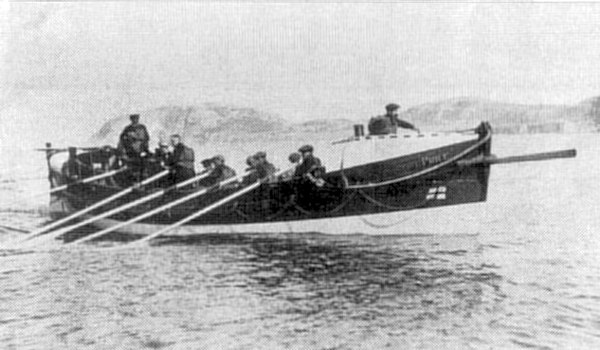 The Kezia Gwilt - 7 May 1915
Southern Star: 22 May 1915
The Coxswain’s Story
I saw the big Cunarder passing eastwards on her way. She was well off the south’ard of the Head. I knew it was the Lusitania; we expected her that day, you can’t mistake four funnels painted red. I thought no more about her for a minute, p’rhaps so; then turned and saw her blowing smoke and steam in volumes to the heavens, while her pace appeared dead slow; she was listing over starboard, so t’would seem. I got the glasses on her, and, ‘Oh, my God, the sight’! May I never see the like of it again. Her bows went slowly under and her stern stood upright. I was certain that the German got her then. We were ready in the water just ten minutes from the call. Away we rowed – no wind to fill a sail. Out on the sea of glass we rowed, pulling with might and main. Well nigh fifteen miles sou’east we went, never an air of wind to help relieve that awful strain. Rowing ‘till the crew were fairly spent. Praying as hard as men could pray, a prayer with every stroke. ‘Oh, God, keep them alive, until we’re there.’ I’ll tell you Sir, we rowed until our heads were well nigh broke. We sweated in the sultry summer glare. There were steamers coming westwards; we could see them off the Head. They had engines to propel them; we had men. We’d have beaten them and saved a hundred lives or more, ‘tis said, if we only had a motor in us then. Men and women, aye, and children, lying face down in the tide. ‘Oh, God!’ it was a pitiable sight. We could see that from exhaustion many of the poor things died as we got their bodies in throughout the night. ‘Twas a cruel, cruel murder of poor innocents, we know. May God’s vengeance on the German hounds descend. But after all our efforts ‘twas a painful, bitter blow that our boat had not one rescue in the end. We’re fitter for a gale of wind and ready day and night to risk our lives our fellow men to save; but rowing miles and miles in calm is neither fit or right. Before we’re there, they’ve sunk beneath the waves. Give us a lifeboat with motor power, certain to save lives, something that will take us round the Head. Then we’ll bring the rescued to their sweethearts and wives for we’ll get there ‘fore the sea is strewn with the dead.
7 May 1915 was a very hot day, there was no wind therefore the sail could not be hoisted to assist the crew of the lifeboat. Twelve men toiled at the oars, Timothy Keohane was the Coxswain. Rev. Walter Forde, the local Church of Ireland Rector, who was Hon. Secretary of Courtmacsherry Lifeboat, had been alerted also travelled on the lifeboat. Mr. Mountifort Longfield, a member of the lifeboat committee, who was at sea for some recreational fishing, was picked up by the lifeboat as it passed his vessel and he also accompanied the lifeboat to the scene of the tragedy.
The crew of the lifeboat were older than would be expected. Timothy Keohane was sixty-one years of age. The reason for this was that many of the young men of the area had left and joined the Royal Navy. There was little work available to them in the area and the war provided them with an opportunity for adventure, learning new skills and earning much needed money.
It was after the Lusitania tragedy that that a campaign took off to have a motor lifeboat assigned to Courtmacsherry. The loss of the Cardiff Hall in 1920 added further impetus to the pressure on the RNLI. Eventually, in 1931, Courtmacsherry got a motor lifeboat. The new boat necessitated deeper water for mooring and thus the station was relocated to the village of Courtmacsherry. The RNLI took over the boathouse in the centre of the village that had been vacated by the Coastguard after Independence.
It was named by Mrs. Cosgrave, wife of the President of the Executive Council of Ireland, William T. Cosgrave. The village was en fête for the ceremony as she named the boat the Sarah Ward and William David Crossweller.
The 1926 Census adds to the story of the family of Timothy and Julia Keohane. Living in the house with them were their daughter Hannah, her husband Thomas Mahony, daughter Kathleen and son Fintan. All the other children of the couple had either joined the navy or emigrated. It records Timothy, aged 72, as a farmer with six acres of land. His son-in-law was employed as an engine driver by Barryroe Co-Operative Society, which had been founded just the previous year 1925.
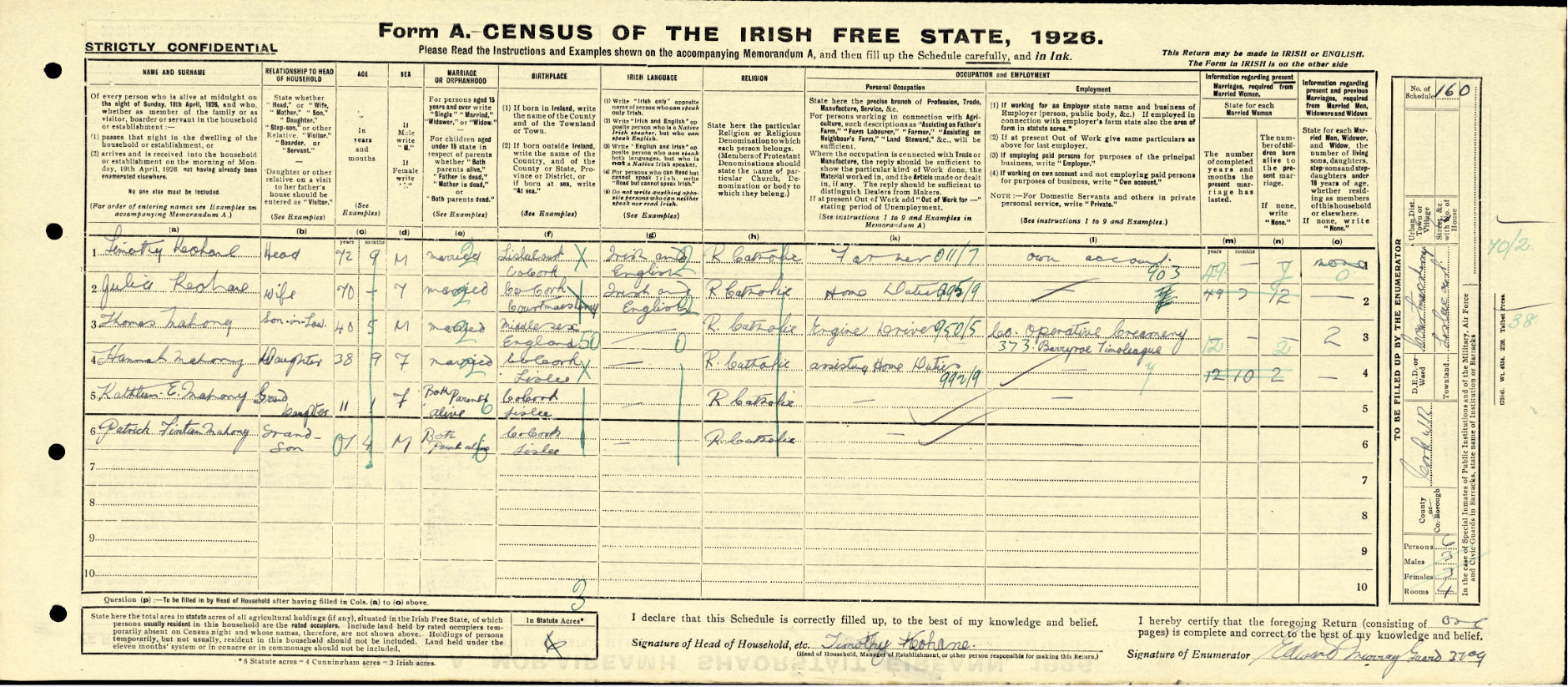 Timothy Keohane 1926 Household Census (click to enlarge)
Unlikely Heroes
Tim Keohane, his wife Julia and their family of twelve seemed typical of those among whom they lived, yet aspects of their life stories set them apart.
Tim Keohane was born at Barry’s Point in 1853, just a few years after the Famine. His wife, Julia Moloney was born three years later. That they were born at all and that they subsequently lived to adulthood at a time of high infant mortality and continuing deprivation is an indication that their parents and they themselves had a strong constitution.
In rural Ireland it was the norm in the second half of the 19th century that people either emigrated or lived in the area where they were born for the rest of their lives. Marriages tended to be contracted between young people who lived within a short distance of each other. So it was that Tim Keohane, aged twenty-four, married Julia Moloney, aged twenty-one, in 1877. Both of them signed the marriage register with an ‘X’, indicating that they were not literate.
Yet, that was not entirely true. Tim Keohane signed the 1901 and 1911 Census Forms with a neat hand, but the 1911 Census indicates that Julia could not read. Perhaps Tim did not want to embarrass Julia on their wedding day, or perhaps the officiating priest was guilty of impatience or presumption. The Census notes that both Tim and Julia could speak both Irish and English.
Over the twenty-four years after her marriage, Julia Keohane gave birth to twelve children. This fact is another indication of the physical strength that typified this family. Giving birth to twelve live children between 1877 and 1901 was, statistically, given infant mortality rates, very unusual. It was also physically taxing, to say the least, for the mother, Julia Keohane who lived to be eighty years of age.
Of the twelve children born to Tim and Julia Keohane, eleven lived to adulthood. Nora, the youngest, died of whooping cough at the age of three. This again is an indication of the good health of the family. Measles, mumps, scarlet fever and diphtheria were other childhood illnesses that often proved fatal and tuberculosis was a scourge that affected young and old alike.
The family lived in a cottage at Barry’s Point. As it no longer exists, it is only possible to make an educated guess as to what it was like. It cannot have been totally satisfactory, as the family were moved to a Council cottage in Lislee in 1907. The cottage at Barry’s Point would have been built of stone and consist of two rooms. Water would have come from a nearby well, light would have been provided by candles and perhaps an oil lamp. An open fire, fuelled by timber and turf would have been used for heat, cooking and drying wet clothes. Coal, imported into Courtmacsherry would have been available too, but its cost could have been prohibitive for a family that lived a marginal existence.
Drying wet clothes must have been a big problem. Tim Keohane was a fisherman and also had a bit of land that he tilled to provide the family with basic food like potatoes and root vegetables. He worked in all weathers and his clothes, neither plentiful or rainproof would have been frequently wet from sea and rain.
The children, too, must have been rained on frequently, as they walked more than two miles over Leaca to Butlerstown School. On wet days, the pupils would huddle, in steaming clothes, around the schoolroom fire. At the end of the school day, they would return homewards, perhaps in rain again.
What was the family diet like? It is true that families that lived at subsistence level did better in rural areas than in the cities because they had access to basic foodstuffs, either by growing them themselves or by barter with neighbours, or both. The Keohanes always maintained that they were well fed. They would have had a ready source of protein in fish and the patch of land would have supplied the family with potatoes and root vegetables. A cow for milk, a pig for bacon and hens for eggs would have been desirable. If the Keohanes did not have these themselves, through the barter system, either offering some of their own produce or labour when needed in exchange, it would have been possible to get some variety into their diet.
It is interesting to note that Patrick and Daniel Keohane both measured 5’1” when they enlisted in the Royal Navy at the age of sixteen. Patrick measured 5’7” two years later and Daniel eventually reached a height of 5’4”. Did the more plentiful and varied diet they received in the navy contribute to these teenagers continuing to grow at this comparatively late stage?